
SailPoint IdentityIQ vs IdentityNow
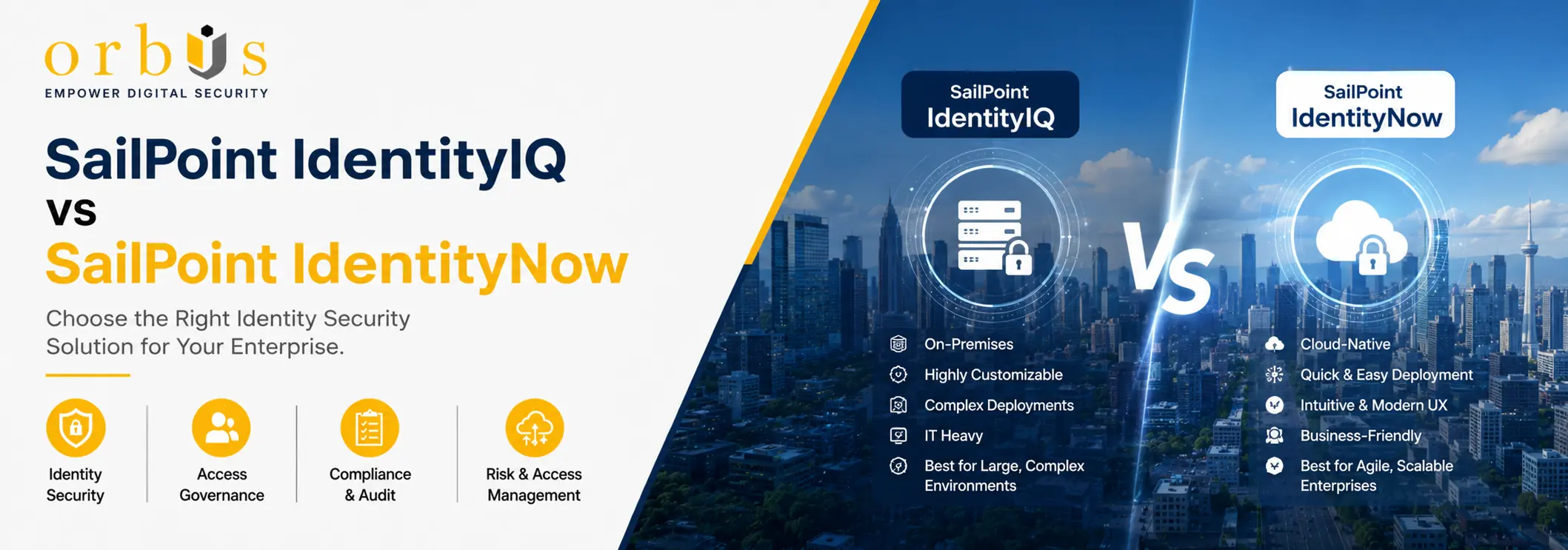
Table of Contents
SailPoint IdentityIQ vs IdentityNow: A Practical Career Guide
Overview
SailPoint IdentityIQ vs IdentityNow .If you’ve started exploring Identity and Access Management (IAM), you’ve likely come across two SailPoint products: IdentityIQ and IdentityNow. In fact, they appear together constantly — in job descriptions, certification paths, and enterprise IAM discussions — which is why many professionals are unsure which one to learn or recommend. At first glance, the difference looks simple: IdentityIQ runs on-premises, while IdentityNow is cloud-based. However, the comparison goes much deeper than that. Specifically, the two platforms differ in deployment model, implementation approach, maintenance, scalability, and customisation, and as a result, each is built for a different type of organisation. That said, both solve the same core problem: ensuring the right people have the right access at the right time, while also meeting governance and compliance requirements. In other words, they simply get there through different architectures and management models. Whether you’re an IT professional planning your IAM career or an organisation evaluating SailPoint solutions, understanding these differences will therefore help you decide with confidence. To that end, this guide compares both platforms, shows where each performs best, and explains which option makes the most sense from a business and career perspective.Understanding SailPoint IdentityIQ
IdentityIQ is SailPoint’s enterprise Identity Governance and Administration (IGA) platform, built for organisations that want complete ownership of their IAM infrastructure. Instead of relying on a cloud service, it’s deployed inside the organisation’s own data centre, private cloud, or virtual environment. For example, large enterprises in banking, insurance, healthcare, manufacturing, government, and other highly regulated sectors have relied on IdentityIQ for years. This is largely because it gives them extensive control over security policies, workflows, integrations, and compliance processes. Because organisations manage the infrastructure themselves, IdentityIQ also offers significant flexibility for custom development. As a result, teams can tailor approval workflows, provisioning processes, reporting, and governance policies to their exact operational needs. IdentityIQ is built on Java-based technologies and typically works with relational databases and enterprise application servers. Consequently, professionals working on the platform usually develop expertise in Java, BeanShell, SQL, XML, and enterprise integrations.Key Features of IdentityIQ
- Identity lifecycle automation: IdentityIQ automates the full employee lifecycle, managing access whenever someone joins, changes roles, or leaves. In addition, teams can build custom workflows that automatically provision, update, or remove access based on business rules.
- Compliance and policy management: The platform supports compliance through access certifications, Separation of Duties (SoD) controls, policy enforcement, and remediation workflows. Notably, these capabilities are particularly valuable during audits.
- Access provisioning services: IdentityIQ provisions access across connected enterprise systems, supporting both automated provisioning and manual fulfilment when direct integrations aren’t available.
- Enterprise integration framework: A broad connector library covers Active Directory, LDAP, SAP, Oracle, databases, and legacy systems. Where pre-built connectors don’t exist, teams can also build custom integrations in Java.
- Reporting and governance insights: A flexible reporting framework helps administrators track user access, certification campaigns, entitlement assignments, and policy violations, with reports customisable to regulatory needs.
Getting Started with SailPoint IdentityNow
IdentityNow — now marketed as SailPoint Identity Security Cloud — is SailPoint’s cloud-first approach to identity governance. Unlike IdentityIQ, organisations don’t install or manage the platform themselves; instead, SailPoint delivers it as a fully managed Software-as-a-Service (SaaS) solution. As a result, this removes much of the operational overhead that comes with maintaining enterprise IAM infrastructure. Moreover, the rebrand to Identity Security Cloud reflects broader capabilities: alongside identity governance, it now includes AI-driven recommendations, identity intelligence, workload identity support, and advanced cloud-native security features.Main Capabilities of IdentityNow
- Automated identity lifecycle: IdentityNow manages onboarding, internal transfers, and offboarding automatically, responding to events from HR systems and connected identity sources so that users get the right access throughout their employment.
- Self-service access management: Users can request access through a self-service portal, while configurable approval workflows route requests to managers or application owners. Once approved, provisioning then happens automatically.
- Access review and certification: Managers and application owners can review permissions through automated certification campaigns. In turn, IdentityNow logs decisions, tracks completion, and produces audit-ready evidence with minimal manual effort.
- Cloud integration connectors: Built-in connectors cover cloud applications, HR platforms, and directories, while REST API support also enables integration with systems that lack pre-built connectors.
- Intelligent access recommendations: AI analyses access patterns to recommend appropriate permissions, assist certification decisions, and support role optimisation — a capability that continues to expand across Identity Security Cloud.
IdentityIQ vs IdentityNow: Feature Comparison
Both platforms manage identities, automate access, and strengthen governance. However, they take different approaches to deployment, maintenance, and administration. The table below therefore highlights the differences that matter most when comparing the two.| Feature | SailPoint IdentityIQ | SailPoint IdentityNow / Identity Security Cloud |
| Deployment | On-premises or private cloud | Multi-tenant SaaS |
| Architecture | Java-based platform with application server and database | Cloud-native microservices architecture |
| Implementation time | Usually several months, depending on project complexity | Typically weeks to a few months |
| Customisation | Extensive Java-based customisation | Configuration-driven, with limited custom coding |
| Technical skills | Java, J2EE, BeanShell, SQL, XML | REST APIs, configuration, lightweight scripting |
| Platform maintenance | Managed by the customer | Managed by SailPoint |
| Licensing | Perpetual licence plus infrastructure costs | Subscription-based pricing |
| Integrations | Strong support for legacy systems and custom connectors | Optimised for SaaS applications and REST APIs |
| AI features | Limited native AI capabilities | Built-in AI recommendations and identity insights |
| Scalability | Depends on customer infrastructure | Scales automatically in the cloud |
| Data control | Full customer control | Managed by SailPoint, with regional options |
| Best fit | Large, regulated enterprises | Cloud-first organisations and growing businesses |
Planning a Successful IdentityIQ to IdentityNow Migration
Many organisations currently running IdentityIQ are exploring a move to Identity Security Cloud. Although both platforms belong to SailPoint, migrating between them involves far more than simply transferring configurations.What Changes During Migration?
Migration usually means redesigning workflows, rebuilding custom logic, reviewing integrations, and adapting governance policies to IdentityNow’s cloud architecture. For instance, custom Java code written for IdentityIQ generally can’t be transferred directly, and legacy connectors may need to be replaced or rebuilt using REST APIs or cloud-native integrations. Because of this, many organisations end up treating the project as a fresh implementation rather than a simple migration.Evaluating Migration Readiness
Before migrating, organisations typically assess their current IdentityIQ deployment by reviewing:- Existing integrations
- Identity data
- Governance processes
Common Challenges During Migration
A few challenges, in particular, show up repeatedly in migration projects:- Heavy dependence on custom Java development
- Legacy applications without modern APIs
- Complex identity and entitlement data migration
Which Platform Should You Learn for Your Career?
Both platforms continue to create career opportunities. That said, demand is shifting. For example, IdentityNow skills are becoming increasingly valuable as organisations adopt cloud-based Identity Governance solutions. As a result, employers are actively looking for professionals who understand lifecycle management, access requests, governance workflows, connectors, REST APIs, and cloud integrations. On the other hand, IdentityIQ remains highly relevant in enterprises that still run large on-premises environments. In particular, experienced IdentityIQ professionals with Java and implementation expertise are in demand for consulting, migration, and enterprise support projects. Ultimately, for a long-term IAM career, learning both platforms gives you the greatest flexibility. Additionally, understanding how IdentityIQ and IdentityNow work together during migration projects can open up further consulting opportunities.Best SailPoint IdentityNow Training Providers in India (2026)
If you’re ready to build hands-on SailPoint skills, here’s how leading Indian training providers compare, specifically on fees, duration, eligibility, and certification:| Provider | Fees | Duration | Eligibility | Certification |
| Orbus International | ₹25,000 | 40–45 hrs | IT professionals / networking background | Yes |
| InfosecTrain | ₹20,000–35,000 | 35–40 hrs | Basic IT / cybersecurity knowledge | Yes |
| Koenig Solutions | ₹22,000+ | 32–40 hrs | IT professionals | Yes |
| MindMajix | ₹15,000–25,000 | 35–40 hrs | Basic IT knowledge | Yes |
| HKR Trainings | ₹10,000–20,000 | Flexible | Open to all | Yes |
| Tekslate | ₹12,000–20,000 | Flexible | Basic IT knowledge | Yes |
| Cloud Foundation | ₹18,000–30,000 | 35–45 hrs | IT professionals | Yes |
| Simplilearn | ₹20,000+ | Flexible / self-paced | Open to all | Yes |
Conclusion
Ultimately, SailPoint IdentityIQ and IdentityNow (Identity Security Cloud) are built to solve the same business challenge: managing identities, controlling access, and supporting compliance. The real difference, however, lies in how each is deployed, maintained, and scaled. On one hand, IdentityIQ remains a strong choice for organisations that need extensive customisation, strict infrastructure control, and support for complex legacy environments. On the other hand, IdentityNow is built for organisations embracing cloud-first strategies. With SaaS delivery, AI-powered identity insights, automatic platform updates, and simplified administration, it therefore helps businesses modernise identity governance while cutting infrastructure overhead. So, if you’re looking to build practical IAM expertise, Orbus International offers structured training through live instructor-led sessions, real-world lab exercises, certification preparation, and career guidance. Programme Duration: 40 Hours | Fee: ₹25,000 | Delivery Format: Live Online + Corporate TrainingFrequently Asked Questions
1. What is the primary difference between IdentityIQ and IdentityNow?
The biggest difference is the deployment model. Specifically, IdentityIQ is an on-premises identity governance platform that offers extensive customisation, while IdentityNow (Identity Security Cloud) is a cloud-native SaaS solution managed by SailPoint. As a result, IdentityNow needs less infrastructure management and gets automatic updates, whereas IdentityIQ gives you greater control over custom development and deployment.2. Does IdentityNow completely replace IdentityIQ?
Not entirely. IdentityNow represents SailPoint’s cloud-first direction; however, IdentityIQ is still actively used by many enterprises that need extensive customisation or run complex legacy infrastructure. In other words, the right choice depends on business requirements, not one platform simply replacing the other.3. Is coding required for IdentityIQ and IdentityNow?
IdentityIQ generally requires stronger technical skills, since customisations often involve Java, BeanShell, SQL, XML, and enterprise application development. In contrast, IdentityNow focuses more on configuration, REST APIs, workflow design, and cloud integrations, which makes it less code-intensive for most administrative tasks.4. What should I learn first — IdentityIQ or IdentityNow?
If your goal is to work with modern cloud environments, IdentityNow is generally the better starting point. That said, if you’re targeting organisations with mature on-premises IAM systems or implementation consulting roles, learning IdentityIQ can be equally valuable. Either way, understanding both platforms opens up the broadest range of career opportunities.5. Which platform offers better career and salary growth?
Both offer strong growth, although the trajectory differs. On one hand, IdentityNow and Identity Security Cloud skills are in rising demand as more enterprises move to the cloud, which is creating fresh openings for early-career professionals. On the other hand, IdentityIQ specialists, especially those with Java and implementation experience, continue to command strong rates in consulting and enterprise support, where fewer professionals have deep hands-on expertise.SEO Recommendations for Publishing
The notes below are for whoever publishes this post on your CMS — they are not part of the article body. Suggested meta title: SailPoint IdentityIQ vs IdentityNow: Career Guide (2026) — 58 characters Suggested meta description: Compare SailPoint IdentityIQ and IdentityNow (Identity Security Cloud) on architecture, skills, and career paths — and see which one to learn first. — 152 characters Suggested URL slug: /sailpoint-identityiq-vs-identitynow-career-guide Focus keyword: SailPoint IdentityIQ vs IdentityNow Secondary keywords: SailPoint IdentityNow training, Identity Security Cloud, SailPoint IAM career, SailPoint IdentityIQ certification On-page changes already made in this draft:- Converted every section into a real H1/H2/H3 heading hierarchy (the original used bold text only, which Yoast and search engines can’t read as headings — this fixes the “Subheading distribution” red flag).
- Added transition words throughout (however, as a result, for example, on the other hand, in contrast, etc.) to lift the transition-word score from Yoast’s flagged 16.3% to well above its ~30% target.
- Front-loaded the focus keyword in the title, opening paragraph, and conclusion.
- Fixed the FAQ numbering (the original skipped from question 1 to question 3) and added a 5th question to capture salary/career-growth searches.
- Removed an internal drafting note that had been left in the training-providers section.
- Fixed a truncated table header (“Certif ication” → “Certification”).
- Shortened long paragraphs to 2–4 sentences to improve readability and scannability on mobile.
- In Yoast’s SEO tab (currently showing “Not available”), enter a focus keyphrase — e.g. SailPoint IdentityIQ vs IdentityNow — so Yoast can actually score the SEO side, not just readability.
- Add 2–3 original images or diagrams (e.g. an architecture comparison graphic) with descriptive alt text containing the focus keyword.
- Link internally to related posts (e.g. SailPoint certification guides, IAM career pages) and externally to SailPoint’s official product pages.
- Mark up the FAQ section with FAQPage schema so questions are eligible for rich snippets in search results.
Understand how Orbus can help your career!
Speak with an Expert Now!