Top 50 SailPoint IdentityNow Interview Questions & Answers (2026)

Top 50 SailPoint IdentityNow Interview Questions & Answers (2026)

Top 50 SailPoint IdentityNow Interview Questions & Answers for 2026

Top 50 SailPoint IdentityNow Interview Questions & Answers (2026)

.Job-hunting in identity governance right now means one thing above all else: recruiters keep circling back to SailPoint IdentityNow. Most enterprises have standardized on it for cloud-based identity governance. Interview panels know the platform well, and they dig past textbook definitions fast.

A question about access certifications can quickly turn into: “Walk me through what happens when a campaign fails halfway through.” Suddenly, the memorized answer isn’t enough.

This guide compiles 50 SailPoint IdentityNow interview questions, split across intermediate and advanced difficulty — the way they actually show up in real panels: IAM analyst rounds, SailPoint admin interviews, testing-focused screens.

  • Freshers will find enough grounding here to hold a conversation about identity governance without freezing up.
  • Experienced professionals will find the scenario-based questions that separate “I’ve used it” from “I’ve owned it.”

Nobody gets asked all 50 in one sitting. Treat this as a map of the territory, not a script to memorize.

SailPoint IdentityNow Interview Questions for Intermediate Level

Expect this stretch once an interviewer knows you understand what IdentityNow is and wants to see whether you’ve actually configured anything in it. This typically applies one to three years into an IAM role, or fresh off a SailPoint training course.

Governance, Certifications & Controls

1. What is SailPoint IdentityNow?
SailPoint’s SaaS identity governance platform. It handles certifications, access requests, provisioning, password management, and SoD enforcement entirely from the cloud. The difference from a generic IAM tool is governance depth — it doesn’t just grant access, it continuously verifies that access still makes sense.

2. How would you explain identity governance to someone outside IT?
A rulebook and an enforcement system combined — deciding who should have access to what, then checking back periodically to confirm that’s still the right call.

3. Walk me through an access certification campaign.
A campaign gets triggered, and IdentityNow pulls relevant access data into a report. That routes to a manager or application owner, who approves, revokes, or flags each entitlement. The system logs every decision, and unactioned items escalate automatically.

4. What’s the difference between a preventive arnd a detective control?
Preventive controls stop a problem before it happens — blocking a request that violates an SoD rule. Detective controls catch issues after the fact, flagging conflicting access that slipped through some other channel.

5. How does Separation of Duties (SoD) work, and why does it matter?
SoD policies define access combinations that conflict — like creating a vendor and approving payment to that same vendor. IdentityNow checks new requests against these policies and scans for conflicts elsewhere. It matters because it’s usually the first thing auditors check.

Provisioning, Lifecycle & Access

6. Explain provisioning and de-provisioning.
Provisioning automatically grants access tied to a role, usually triggered by an HR event. De-provisioning reverses that when someone leaves, closing the gap where former employees keep active accounts.

7. What problem does Lifecycle Manager solve?
It automates access changes tied to joiner, mover, and leaver events, so nobody has to manually update access every time someone changes roles.

8. How does MFA fit into IdentityNow’s architecture?
It adds a second verification step — push notification, OTP, or biometrics — on top of password login, and extends into access requests and certifications for sensitive actions.

9. What is RBAC, and how does IdentityNow apply it?
RBAC groups individual entitlements into roles mapped to job functions. IdentityNow’s role mining tools build these from actual usage patterns, not guesswork.

10. How does IdentityNow integrate with other systems?
Through pre-built connectors for common targets like Active Directory and Workday, plus REST APIs and SCIM support for anything custom.

Workflows, Analytics & Security

11. How does the access request approval workflow run?
A user submits a request through a self-service catalogue. It routes to one or more approvers based on policy, and once approved, provisioning happens automatically or moves to a fulfilment queue.

12. How does IdentityNow support compliance reporting?
It keeps a full audit trail of every access decision and violation, generates reports formatted for whichever regulation applies, and gives compliance teams a live dashboard view.

13. What’s the role of Identity Analytics?
It flags anomalies — a user with unusually broad access compared to peers in the same role, for instance. This moves governance from “did we follow process” to “does this access make sense.”

14. How does password management work?
It centralizes resets and synchronization across connected apps. Self-service reset cuts help desk tickets significantly.

15. What’s a Cloud Connector, and when would you use one?
It lets IdentityNow talk to SaaS applications without a local agent. Use one when the target app is cloud-native and supports the connector’s protocol, avoiding the overhead of a Virtual Appliance.

Platform Architecture & Campaign Mechanics

16. What is an Identity Cube?
The complete profile of one identity — every account, entitlement, and attribute pulled together from all connected systems into a single governed record.

17. IdentityNow vs. IdentityIQ — when would a company pick one over the other?
IdentityIQ runs on-prem with deep customization. IdentityNow is multi-tenant SaaS built for faster deployment. Companies needing heavy customization lean IdentityIQ; companies prioritizing speed lean IdentityNow.

18. How does role mining work?
It analyzes existing access data for entitlement patterns that consistently appear together, then suggests these as candidate roles, built from real usage instead of guesswork.

19. What happens technically when a certification campaign is created?
The system snapshots relevant access data based on the campaign’s scope, assigns items to reviewers by certification type, then generates the review interface and notifications.

20. Why run more than one type of certification campaign?
Different risks need different angles. Manager certification checks if access is still needed. Entitlement owner certification checks if access is appropriate. Role composition certification checks if the role itself is still accurate.

SailPoint IdentityNow Interview Questions for Advanced Level

This is where the conversation shifts from definitions to judgment calls — senior IAM roles, SailPoint admin positions on live tenants, or panels where the interviewer has clearly broken something in IdentityNow before.

Diagnosing Campaign & Policy Issues

21. A certification campaign is stuck at 60% past its deadline. How do you diagnose it?
Check if the stall is concentrated with specific reviewers or spread evenly — that tells you workload problem versus system problem. Concentrated stalls need escalation rule checks; spread-out stalls often point to a sync issue.

22. How would you design an SoD policy when the rules aren’t documented yet?
Pull current access data, find entitlement combinations that already coexist, then confirm with business leadership which ones are genuinely risky — before writing the policy, not after.

23. Describe a time-bound emergency access scenario.
An engineer needs database access during a 2 AM outage. IdentityNow provisions it with a built-in expiration, logs every action, and auto-revokes once the window closes.

24. How would you migrate SoD policies from IdentityIQ to IdentityNow?
You can’t lift-and-shift directly, since the policy engines differ structurally. Inventory every active policy, map each to its closest IdentityNow equivalent, and flag custom rules for rebuilding.

25. A stable connector suddenly stops aggregating correctly. How do you troubleshoot?
Check recent aggregation logs first for authentication or schema errors — often a credential expired or the source system changed structure. If logs are clean, test the connection manually to rule out rate-limiting.

26. How do you handle significant role drift?
Pull current usage data, compare it against documented roles, and quantify the gap. From there, it’s a business call: update the roles, or tighten enforcement.

Governance at Scale

27. How would you design governance across multiple regulatory regions?
Segment certification and policy logic by region instead of one global ruleset. Tag identities and applications by region, and make sure reporting can slice by jurisdiction.

28. How do you test configuration changes before pushing to production?
A sandbox tenant mirroring production catches most issues. Check specifically what happens to in-flight certifications during the change — that’s where real problems surface.

29. How would you investigate suspected access creep?
Run an analytics comparison of each identity’s entitlements against their role baseline, sorted by deviation. Send flagged outliers into a targeted certification instead of waiting for the next cycle.

30. How would you structure provisioning for a newly acquired company joining the tenant?
Don’t provision everyone under existing parent roles right away, since job functions rarely map cleanly. Aggregate their existing access as a baseline first, then migrate in phases.

31. How does IdentityNow handle orphan accounts?
They surface through aggregation reports once a source app connects. Investigate each one first — some turn out to be mislabelled service accounts — before disabling or deleting.

32. How would you structure certifications for a 10,000-employee org without overwhelming reviewers?
Segment by risk tier. Review high-risk apps more often, in smaller batches. Bundle low-risk access into longer cycles, and stagger schedules.

Workflows, Connectors & Troubleshooting

33. How would you build a custom workflow for non-standard onboarding?
Map every condition that makes the process non-standard first — contractors versus full-time hires often need different paths. Build branch logic around those points.

34. How do you reduce false positives in SoD violation reports?
Many false positives come from overly broad policy definitions. Review flagged violations periodically with the business owner and document legitimate exceptions.

35. How do you handle an application that can’t be directly connected?
Use a flat-file integration. Scheduled exports feed aggregation and provisioning, bringing the application under governance without a direct connector.

36. How would you explain an audit finding to a non-technical executive?
Translate it into business risk immediately. “Forty percent of access here hasn’t been verified in over a year” lands better than a completion-rate statistic.

37. How would you handle conflicting access needs between two business units sharing one app?
Push for application-level role segmentation instead of one shared role — that’s usually where SoD violations and over-provisioning originate.

38. When would you build a custom connector versus using a generic one?
Generic connectors work fine when the target API is well-documented. Go custom only when the integration needs logic a generic connector can’t express.

39. How do you approach performance issues during large aggregation runs?
Isolate whether the bottleneck sits on IdentityNow’s side or the source system’s side first. If it’s IdentityNow-side, review scheduling overlap and narrow the aggregation scope.

Reporting, Stakeholders & Validation

40. How would you design reporting for three different regulatory bodies?
Build the underlying data model once. Keep the reporting layer flexible per regulation, and avoid maintaining three separate, drifting report definitions.

41. How do you handle stakeholder pushback on certification frequency?
Bring data into the conversation — certification outcomes over time, how much access actually gets revoked per cycle. Let the data argue the case.

42. How do you validate a new role doesn’t introduce SoD conflicts?
Run it through policy validation against every existing rule. Then manually review it against adjacent department roles, since conflicts sometimes only emerge when one person holds two roles together.

43. How do you recover from a failed provisioning action with partial access granted?
Check provisioning logs to identify which steps succeeded. Manually complete or roll back the incomplete pieces, then investigate the root cause.

44. Native workflow engine versus external orchestration — how do you decide?
Native workflows handle standard lifecycle logic well. Once a process needs systems entirely outside IdentityNow’s reach, external orchestration tends to be cleaner.

45. How would you audit a tenant-wide configuration before a major compliance review?
Start with policies and certification configurations, since auditors scrutinize those most closely. Then sample a cross-section of identities.

Legacy Systems, Technical Debt & Strategy

46. How would you integrate a legacy mainframe with no modern API?
Usually a Virtual Appliance with a connector built for whatever interface the mainframe exposes — a flat file, a database table, or a legacy protocol.

47. How do you manage technical debt in a tenant running for years?
Run a periodic audit cycle to inventory configuration that’s accumulated without documentation — undocumented rules, dead connectors, outdated campaign scopes.

48. Expanding IdentityNow’s footprint versus adding point solutions — how do you advise?
Confirm whether the gap is a genuine capability gap or just a configuration gap in what’s already there. Point-solution sprawl often happens because teams don’t realize IdentityNow already covers it.

49. Give an example of a senior-level scenario question and how you’d structure the answer.
“Access reviews are taking too long — how do you fix it without compromising governance?” Structure the answer around diagnosis before solution.

50. What’s the most common mistake organizations make implementing IdentityNow?
Treating it as a purely technical rollout instead of organizational change. The platform can be configured correctly and still fail if stakeholders treat certifications as a box-ticking exercise.

Conclusion

Fifty questions sounds like a lot until you realize most interviews test just two things: do you understand why identity governance matters, and can you reason through a mess when the textbook answer doesn’t fit.

  • The intermediate set covers the vocabulary and core mechanics you need so you don’t sound lost early on.
  • The advanced set is what actually separates candidates — not who memorized the most features, but who’s sat with a broken campaign at 9 PM and figured out why it broke.

The gap between reading this list and being ready for the room is hands-on practice. That’s exactly the grounding the SailPoint IdentityNow training course at CyberSec Trainings builds around.

Whether you’re a fresher breaking into IAM or already managing a live tenant, it’s worth a look before your next interview.
Top 6 SailPoint IdentityNow Training Options for Amritsar

Top 6 Online SailPoint IdentityNow Training in Amritsar:

Top 6 SailPoint IdentityNow Training Options for Amritsar Learners: Fees & Certification (2025)

Top 6 SailPoint IdentityNow Training Options for Amritsar…If you’re based in Amritsar and considering a career in identity security, SailPoint IdentityNow training could be the smartest move you make this year.

SailPoint IdentityNow is a cloud-native Identity Governance and Administration (IGA) platform that helps organizations control who has access to what — across on-prem systems and cloud applications alike. It handles automated provisioning, access certifications, role management, and compliance reporting, making it essential for enterprise IT and security teams.

Enterprises across India are rapidly adopting SailPoint Identity Security Cloud, and certified professionals who can configure and manage the platform remain in short supply. The good news for Amritsar residents: you don’t need to relocate to get world-class training. Flexible online options make it entirely possible to build this skill set from where you are.

This guide breaks down the top 6 SailPoint IdentityNow training providers, their fees, and everything you need to know about earning your certification.


Top 6 SailPoint IdentityNow Training Providers in India (2025)

Choosing the right training partner matters more than most people realize. Here’s an honest comparison of the six best options available to learners in Amritsar:

Provider Fees Duration Eligibility Certification
CyberSec Trainings ₹15,000 40 hrs IT/CS background preferred Yes
Udemy ₹499–₹3,499 Flexible No prerequisites Yes
Coursera ₹2,500/month 30–50 hrs Basic IT knowledge Yes
Simplilearn ₹18,000 45 hrs Graduate/working professional Yes
NIIT ₹20,000 48 hrs IT background preferred Yes
SailPoint Official On request 40+ hrs IT/IAM professionals Yes

Why Choose CyberSec Trainings for SailPoint IdentityNow?

Duration: 40 hours  |  Fees: ₹15,000

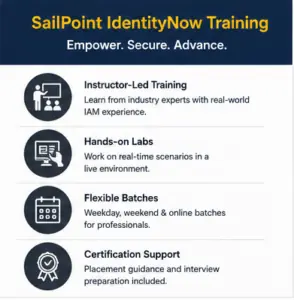
There’s no shortage of SailPoint training options online, but most leave you with slide decks and theory — not a real sense of what it feels like to work inside the platform. CyberSec Trainings is built differently: every instructor has direct enterprise IAM experience, every module maps to real deployment scenarios, and the program prepares you for both the certification exam and the job.

1. A Curriculum That Reflects Real-World Demands

Course content isn’t lifted from outdated documentation. It’s built around what identity security teams handle daily:

  • Provisioning workflows
  • Access certification campaigns
  • Role explosions and SoD conflicts
  • Connector troubleshooting

Modules cover identity lifecycle management, compliance automation, role modeling, and platform integrations — all updated to the current version of SailPoint IdentityNow.

2. Learning That Doesn’t Stop After Class

  • Recorded sessions you can rewatch anytime
  • Printed and digital study materials you can annotate
  • Instructor-led live classes where you can ask real questions

You’re never dependent on a single revision session the night before the exam.

3. Instructors Who Have Actually Done the Job

Instructors are certified SailPoint practitioners who’ve configured the platform for real organizations and handled edge cases that never appear in textbooks. That experience shows in every session.

4. Works Around Your Schedule

Whether you’re a student juggling coursework, a working professional training in the evenings, or a corporate team seeking group training, batch options are built to fit — not the other way around.

5. Hands-On Labs, Not Just Slides

You’ll work inside simulated IdentityNow environments doing real tasks:

  • Setting up identity profiles
  • Running access reviews
  • Configuring provisioning policies
  • Completing real-world integration scenarios

AI-assisted identity techniques and current platform updates are built into the labs, so what you learn stays relevant.

6. Full Certification Preparation

CyberSec Trainings prepares you to pass the SailPoint IdentityNow Professional Certification on your first attempt, with structured exam prep, mock tests mirroring the real assessment, and guidance on tackling different question types. The credential is globally recognized and carries real weight with hiring managers.


SailPoint IdentityNow Training Programs Offered

CyberSec Trainings designs its SailPoint Identity Security Cloud programs around what the industry actually needs:

1. SailPoint IdentityNow Core Training The starting point for most learners. Covers platform architecture, source connectors, identity profiles, lifecycle states, and the provisioning engine — building confident, ground-up understanding of how IdentityNow works.

2. Access Certification & Compliance Management Focuses on automating access reviews to keep organizations compliant without burying compliance teams in spreadsheets. Learn to design certification campaigns, configure SoD policies, handle revocations, and produce audit-ready reports.

3. Role Management & Automated Provisioning Covers enterprise role design — mapping entitlements to business roles and building joiner-mover-leaver workflows so access follows the person, not a helpdesk ticket. Ideal for administrators managing large, complex user populations.

4. Integration & Connector Development An advanced track for connecting IdentityNow to enterprise applications and customizing data flow. Covers SailPoint’s connector framework, API-driven integrations, and identity workflows across hybrid environments.


Who Can Apply for SailPoint IdentityNow Training?

This training isn’t reserved for people with five years of IAM experience already under their belt. If you work in or around IT and are willing to put in focused effort, there’s a clear entry point:

  • IT security professionals moving into identity governance
  • System and network administrators managing user access
  • IAM/IGA professionals validating or deepening SailPoint skills
  • Compliance officers handling access reviews and audits
  • Security auditors and risk management professionals
  • Fresh graduates in IT, Computer Science, or Engineering
  • Working professionals in Amritsar pivoting into cybersecurity

Why Join CyberSec Trainings?

Good training should give you more than a certificate to print. Enrollment gets you:

  • Training resources — structured manuals, lab guides, and examples from real enterprise deployments
  • Hands-on projects — real configuration tasks inside simulated IdentityNow environments
  • Expert assistance — direct access to certified SailPoint practitioners
  • Certification prep — mock tests, question walkthroughs, and exam strategy sessions
  • Post-course support — updated materials, community discussions, and ongoing Q&A
  • Placement guidance — resume support, interview coaching, and job referrals across India’s cybersecurity hiring network

Conclusion

India’s identity security market is growing fast, and organizations are hiring SailPoint-certified professionals faster than the talent pool can keep up. For someone in Amritsar, the opportunity is real — online training means geography is no longer a barrier to the skills and certification employers are actively looking for.

CyberSec Trainings offers a structured, practitioner-led path from zero to certified, backed by hands-on labs, exam preparation, and post-course support. If you’re ready to stop reading about identity security and start building a career in it, this is where you begin.

Secure your seat today and take the next step with confidence.

Top 6 SailPoint IdentityNow Training Institutes in Hyderabad

sailpoint training in hyderabad

Top 6 SailPoint IdentityNow Training in Hyderabad: Fees & Certification (2026)

Top 6 SailPoint IdentityNow Training Institutes in Hyderabad.Hyderabad has become one of India’s most important IT hubs — and identity governance is one of the fastest-growing specializations you can step into right now.

SailPoint IdentityNow is a cloud-native Identity Governance and Administration (IGA) platform. Enterprises across BFSI, pharma, IT services, and manufacturing use it to manage access at scale, automate who gets access to what, and enforce compliance through continuous access reviews.

Demand for SailPoint Identity Security Cloud professionals in Hyderabad is real and growing — but the supply of certified, job-ready candidates hasn’t kept pace. That gap is your opportunity.

This guide covers the top 6 SailPoint IdentityNow training options in Hyderabad — what they cost, how long they take, and what to check before you enroll — whether you’re a fresher or an experienced IT professional looking to specialize.


Top 6 SailPoint IdentityNow Training Providers in India (2025)

Provider Fees Duration Eligibility Certification
CyberSec Trainings ₹15,000 40 hrs IT/CS background preferred Yes
Udemy ₹499–₹3,499 Flexible No prerequisites Yes
Coursera ₹2,500/month 30–50 hrs Basic IT knowledge Yes
Simplilearn ₹18,000 45 hrs Graduate/working professional Yes
NIIT ₹20,000 48 hrs IT background preferred Yes
SailPoint Official On request 40+ hrs IT/IAM professionals Yes

Why Choose CyberSec Trainings for SailPoint IdentityNow?

Duration: 40 hours  |  Fees: ₹15,000

Hyderabad has no shortage of institutes claiming to “cover” SailPoint. But covering a topic and actually preparing you for the certification exam — and the job — are two different things.

CyberSec Trainings is built around the second goal. Instructors are certified SailPoint practitioners with real enterprise IAM experience, not generalists reading from documentation. The curriculum is updated to the current IdentityNow version, labs are hands-on, and the pace is designed to get you across the finish line.

1. Curriculum Mapped to Real Deployment Scenarios

Every module reflects what identity security teams actually encounter — not textbook theory. You’ll work through:

  • Identity lifecycle management
  • Access certification design
  • Role modeling
  • Segregation of Duties (SoD) policy configuration
  • Connector troubleshooting

The sequence mirrors how IdentityNow is implemented in enterprise environments, and content is updated with each major platform release.

2. Learning Options That Fit Your Life

  • Weekday and weekend batches for working professionals
  • Recorded sessions and digital materials so you can revisit topics anytime
  • Printed guides for offline reference

The pace is intensive but sustainable — designed for people balancing training with a full-time job.

3. Instructors With Real Enterprise Experience

There’s a big difference between someone who’s read about SailPoint and someone who’s configured it for a 50,000-user enterprise. CyberSec Trainings instructors fall into the second group — bringing real-world context and pointing out where documentation and production reality diverge.

4. Freshers Welcome — No IAM Background Required

Searches for “SailPoint IdentityNow training in Hyderabad for freshers” are common for a reason — many graduates want to enter identity governance but aren’t sure they’re ready. This course starts with foundational concepts before moving into platform-specific configuration. A basic IT or CS background is enough to get started.

5. Hands-On Labs With Current Platform Features

You’ll work inside simulated IdentityNow environments on real tasks:

  • Setting up identity profiles
  • Configuring provisioning policies
  • Running access certification campaigns
  • Completing integration exercises

AI-assisted identity techniques and the latest IdentityNow features are built directly into the labs.

6. Certification Preparation That Actually Prepares You

The SailPoint IdentityNow Professional Certification isn’t something you walk into unprepared. The program includes:

  • Mock tests matching the actual exam format
  • Question-type walkthroughs
  • Strategy sessions on time management and weak-area focus

Most students attempt the exam within weeks of finishing and pass on their first attempt.


SailPoint IdentityNow Training Programs Offered

CyberSec Trainings runs several IdentityNow programs so you can start at the right level:

1. SailPoint IdentityNow Core Training The foundational starting point for most learners. Covers platform architecture, source connectors, identity profiles, lifecycle states, and the provisioning engine.

2. Access Certification & Compliance Management Focuses on one of IdentityNow’s most business-critical capabilities. Learn to design certification campaigns, configure SoD policies, handle revocations, and generate audit-ready reports.

3. Role Management & Automated Provisioning Built for administrators and architects managing large user populations. Covers enterprise role design, entitlement mapping, and automated joiner-mover-leaver workflows.

4. Integration & Connector Development An advanced track for extending IdentityNow beyond default configuration — API-driven integrations, custom connectors, and hybrid IT identity workflows.


Who Should Take This Course?

SailPoint IdentityNow training in Hyderabad suits a wide range of learners, including:

  • IT security professionals specializing in identity governance
  • System and network administrators managing enterprise access
  • IAM/IGA professionals validating or upgrading SailPoint skills
  • Compliance officers handling access reviews, SoD policies, and audits
  • Security auditors and risk management professionals
  • Fresh graduates in IT, Computer Science, or Engineering
  • Working professionals transitioning into cybersecurity
  • Corporate teams needing group or batch training

Why Join CyberSec Trainings?

Enrollment gets you:

  • Training resources — practitioner-developed manuals, lab guides, and real deployment examples
  • Hands-on projects — simulated IdentityNow tasks covering provisioning, certifications, role design, and connectors
  • Expert assistance — direct access to certified SailPoint practitioners
  • Certification prep — mock exams, walkthroughs, and exam strategy sessions
  • Post-course support — updated materials, community access, and ongoing Q&A
  • Placement guidance — resume review, interview coaching, and job referrals

Conclusion

Hyderabad’s tech sector keeps growing, and so does demand for professionals who can manage identity at enterprise scale. A SailPoint IdentityNow certification signals to hiring managers that you understand identity governance and are ready to contribute from day one.

The gap between demand and supply of certified professionals in Hyderabad is significant — and it’s your advantage, if you act on it. CyberSec Trainings offers a structured, practitioner-led path with hands-on labs, weekend batches, and a certification track that works — whether you’re a fresher or an experienced professional formalizing your skills.

Reserve your seat today and take the first step toward a career in identity security.

OKTA Training in Bangalore: Fees, Certification & Career in 2026

Launch Your IAM Career with OKTA Training in Bangalore

OKTA Training in Bangalore: Fees, Certification & Career Opportunities in 2026

Cloud adoption has pushed identity security to the top of every IT leader’s priority list. Companies now need professionals who can manage user access, protect sensitive data, and keep authentication secure across dozens of applications. As a result, Okta has become one of the most widely used Identity and Access Management (IAM) platforms on the market, and interest in Okta Training in Bangalore is growing fast among IT professionals who want a future-ready cybersecurity career.

Bangalore, in particular, stands out as one of the best cities to learn Okta. Home to global tech companies, MNCs, product-based firms, and a thriving startup scene, the city gives learners easy access to a wide range of IAM job opportunities right after certification.

Top Okta Training Providers in Bangalore

Choosing the right training provider matters just as much as choosing the right course. Each institute offers a different mix of hands-on practice, mentoring, and certification support, so it’s worth comparing your options before you enroll.Among these options, Orbus International offers one of the most complete learning experiences, combining live instructor-led sessions, practical lab exercises, certification guidance, and personalized mentoring. Self-paced platforms are useful for learning the basics, but structured training with hands-on practice and expert guidance builds a stronger foundation for real-world enterprise environments and certification success.

What Exactly Is Okta?

Okta is a cloud-based Identity and Access Management platform that helps organizations securely authenticate users and control access to applications, systems, and digital resources. By centralizing identity management, it strengthens security while simplifying user access across a company’s entire IT infrastructure.

As businesses expand their cloud environments, managing thousands of users and applications by hand becomes impractical. Okta solves this by providing a single, centralized identity platform for authentication, authorization, and user management.

Core Responsibilities of an Okta Professional

Professionals working with Okta typically handle tasks such as:

  • Configuring Single Sign-On (SSO) so users can securely access multiple applications through one login.
  • Implementing Multi-Factor Authentication (MFA) to strengthen security beyond passwords.
  • Managing users, groups, and attributes through Universal Directory.
  • Automating onboarding, role changes, and offboarding with lifecycle management features.
  • Integrating enterprise applications, APIs, and identity providers into a connected identity ecosystem.

Because every organization depends on secure authentication, Okta skills stay in demand across healthcare, banking, manufacturing, retail, education, and SaaS. This broad adoption makes Okta expertise highly transferable and increasingly valuable in today’s cybersecurity job market.

Why Learn Okta in Bangalore?

Okta training suits professionals from both IT and cybersecurity backgrounds. Whether you’re switching domains or sharpening existing skills, the course delivers practical knowledge that applies across industries — and Bangalore adds a distinct career advantage on top of that.

A Thriving Technology Ecosystem

Bangalore is home to major employers such as Infosys, Wipro, IBM, Accenture, and Cognizant, along with numerous global capability centers (GCCs), product companies, and fast-growing startups. Many of these organizations actively hire IAM professionals, which makes the city an excellent base for building an Okta career.

Strong Earning Potential

Meanwhile, salaries for identity professionals continue to climb as businesses strengthen their cloud security and Zero Trust strategies. Typical salary ranges include:

  • Entry-level professionals: ₹4–6 LPA
  • Professionals with 2–5 years of experience: ₹8–15 LPA
  • Senior IAM consultants and architects: ₹20 LPA and above

Actual compensation depends on factors like hands-on experience, technical expertise, certifications, and the organization you join.

Global Career Opportunities

Beyond Bangalore, Okta is a globally recognized IAM platform used across the United States, the United Kingdom, the Middle East, and many other regions. That makes Okta a highly portable skill, one that opens doors to both remote and international roles. As more companies move to the cloud and tighten identity security, professionals with hands-on Okta expertise will likely stay in high demand.

Who Should Take This Course?

Okta training is built for professionals from diverse IT backgrounds who want to build or advance a career in Identity and Access Management. This course suits:

  • System and IT administrators planning to move into cybersecurity.
  • Network engineers and cloud professionals managing enterprise infrastructure.
  • Security analysts and SOC professionals looking to expand their IAM expertise.
  • IAM professionals who want to specialize in the Okta platform.
  • Fresh graduates and career changers with a basic understanding of networking or cloud technologies.

What Does the Okta Syllabus Cover?

A well-designed Okta training program builds conceptual understanding first, then moves into practical implementation. Rather than focusing only on theory, the curriculum prepares learners for real enterprise environments. A typical Okta course covers:

  • Introduction to Okta architecture and Universal Directory
  • Configuring Single Sign-On (SSO) and Multi-Factor Authentication (MFA)
  • Managing users, groups, profile attributes, and mappings
  • Automating user lifecycle management and access policies
  • Integrating enterprise applications and external identity providers
  • Identity governance, compliance, and security best practices
  • Troubleshooting, monitoring, and performance optimization

Many training providers also open with an Okta Essentials module, giving beginners a solid foundation before moving into advanced topics. Throughout the course, hands-on labs and real-world implementation scenarios help learners build skills they can apply directly on the job.

Learning Modes: Online, Self-Paced & Free Options

Every learner has a different schedule, so most Okta training providers offer several formats to suit students, working professionals, and career changers:

  • Live Online Training – Interactive instructor-led sessions with real-time demos, practical labs, and live Q&A support.
  • Self-Paced Learning – Recorded modules with LMS access, letting you study on your own schedule — ideal for working professionals.
  • One-to-One Mentoring – Personalized sessions that offer focused guidance, faster learning, and individual attention from experienced trainers.

If you’re still deciding whether IAM is the right career path, start with free resources online. Introductory videos on Single Sign-On, Multi-Factor Authentication, and user management can help you understand the platform before you commit to a full training program.

Okta Training Fees in Bangalore

Most Okta training programs aim to make learners job-ready quickly. Depending on the format, weekday and weekend batches typically take 4 to 6 weeks to complete, and many institutes also offer fast-track programs for professionals in a hurry.

Okta training fees in Bangalore generally range from ₹20,000 to ₹45,000. The final cost depends on the training provider, course content, practical lab sessions, certification preparation, and placement assistance. Price matters, but a program built around hands-on learning and delivered by experienced trainers usually delivers far better long-term value than the cheapest option on the list.

Certification & Career Opportunities

Completing an Okta training program becomes even more valuable when paired with an industry-recognized certification. Credentials such as Okta Certified Professional and Okta Certified Administrator prove your practical knowledge of the platform and boost your credibility with employers worldwide.

Once you’ve gained hands-on experience and certification, several in-demand roles open up, including:

  • Okta Administrator
  • IAM Engineer
  • Identity and Access Management Consultant
  • Security Analyst
  • SSO and Cloud Security Specialist

You’ll find these roles across IT service companies, MNCs, consulting firms, and product-based organizations in Bangalore. As businesses keep investing in cloud technologies and Zero Trust security models, demand for skilled identity professionals should stay strong, making Okta expertise a solid long-term career investment.