

In today’s digital-world, ethical hacking and cyber security are two of the most in-demand technology fields. While many people use these terms interchangeably, they are not the same. Understanding the difference between ethical hacking vs cyber security is crucial if you’re planning a career in information security or choosing the right certification. This guide will clearly explain what ethical hacking is, what cyber security means, how they differ, career paths, skills, salaries, and which one is best for you.

What is Ethical Hacking?
Ethical hacking is the practice of legally breaking into systems, networks, or applications to identify security vulnerabilities before malicious hackers exploit them.
Ethical hackers think like attackers—but work for defense and prevention.
Key Objectives of Ethical Hacking
- Identify system vulnerabilities
- Simulate real-world cyberattacks
- Strengthen organizational security
- Prevent data breaches
Common Ethical Hacking Activities
- Penetration testing
- Network scanning
- Vulnerability assessment
- Web and mobile app testing
- Social engineering simulations
Ethical Hacking Tools
- Nmap
- Metasploit
- Burp Suite
- Wireshark
- SQLmap
- Kali Linux
What is Cyber Security?
Cyber security is a broader discipline focused on protecting systems, networks, and data from cyber threats. It includes policies, technologies, processes, and people working together to prevent attacks.
Cyber security focuses more on defense, monitoring, and risk management.
Core Areas of Cyber Security
- Network security
- Application security
- Cloud security
- Endpoint security
- Information security
- Governance, Risk & Compliance (GRC)
- Incident response & SOC operations
Cyber Security Tools & Technologies
- Firewalls
- SIEM tools (Splunk, QRadar)
- IDS/IPS systems
- Antivirus & EDR
- IAM solutions (Okta, SailPoint, Ping Identity)
Also read: 50 Ethical Hacking Interview Questions and Answers You Must Know
Ethical Hacking vs Cyber Security
| Feature | Ethical Hacking | Cyber Security |
|---|---|---|
| Scope | Narrow & specialized | Broad & strategic |
| Focus | Finding vulnerabilities | Preventing, detecting & responding |
| Approach | Offensive security | Defensive security |
| Objective | Break systems ethically | Protect systems continuously |
| Tools | Pen-testing tools | Firewalls, SIEM, EDR |
| Career Type | Technical & hands-on | Technical + managerial |
Skills Required: Ethical Hacking vs Cyber Security
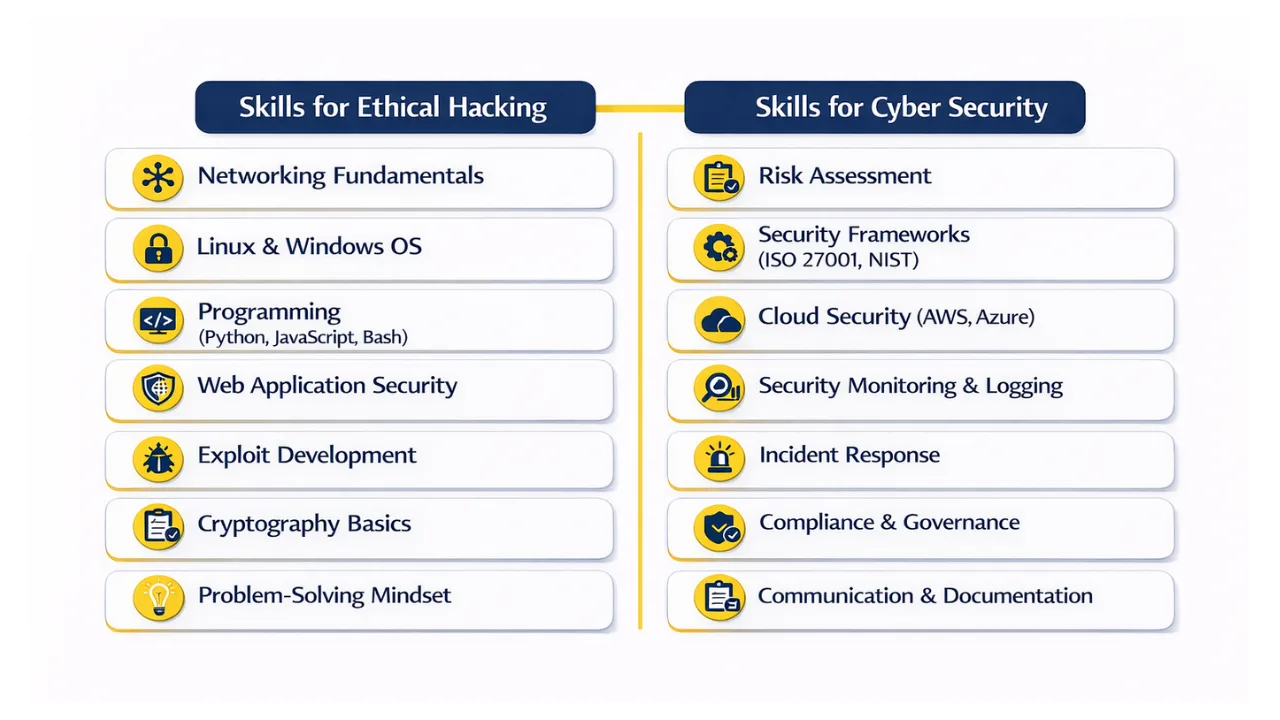
Skills for Ethical Hacking
- Networking fundamentals
- Linux & Windows OS
- Programming (Python, JavaScript, Bash)
- Web application security
- Exploit development
- Cryptography basics
- Problem-solving mindset
Skills for Cyber Security
- Risk assessment
- Security frameworks (ISO 27001, NIST)
- Cloud security (AWS, Azure)
- Security monitoring & logging
- Incident response
- Compliance & governance
- Communication & documentation
Certifications Comparison
Ethical Hacking Certifications
- Certified Ethical Hacker
- OSCP
- GPEN
- EJPT
- CRTO
Cyber Security Certifications
- CompTIA Security+
- CISSP
- CISM
- CCSP
- SOC Analyst Certifications
Career Opportunities
Ethical Hacking Job Roles
- Ethical Hacker
- Penetration Tester
- Vulnerability Analyst
- Red Team Engineer
- Security Tester
Cyber Security Job Roles
- Cyber Security Analyst
- SOC Analyst
- Security Engineer
- Cloud Security Architect
- GRC Consultant
- CISO (Senior-level)
Salary Comparison
Ethical Hacking Salary
- Fresher: ₹4–6 LPA
- Mid-level: ₹8–12 LPA
- Senior: ₹15–25+ LPA
Cyber Security Salary
- Fresher: ₹5–7 LPA
- Mid-level: ₹10–15 LPA
- Senior: ₹20–40+ LPA
Which is Better: Ethical Hacking or Cyber Security?
Choose ethical hacking if you:
- Love hands-on hacking
- Enjoy finding bugs
- Want fast technical growth
- Prefer offensive security roles
Choose cyber security if you:
- Like strategy & defense
- Want leadership roles
- Prefer stable long-term careers
- Enjoy risk management & architecture
Read More: Job Opportunities after Penetration Testing Certification in 2025
Ethical Hacking vs Cyber Security: Learning Path
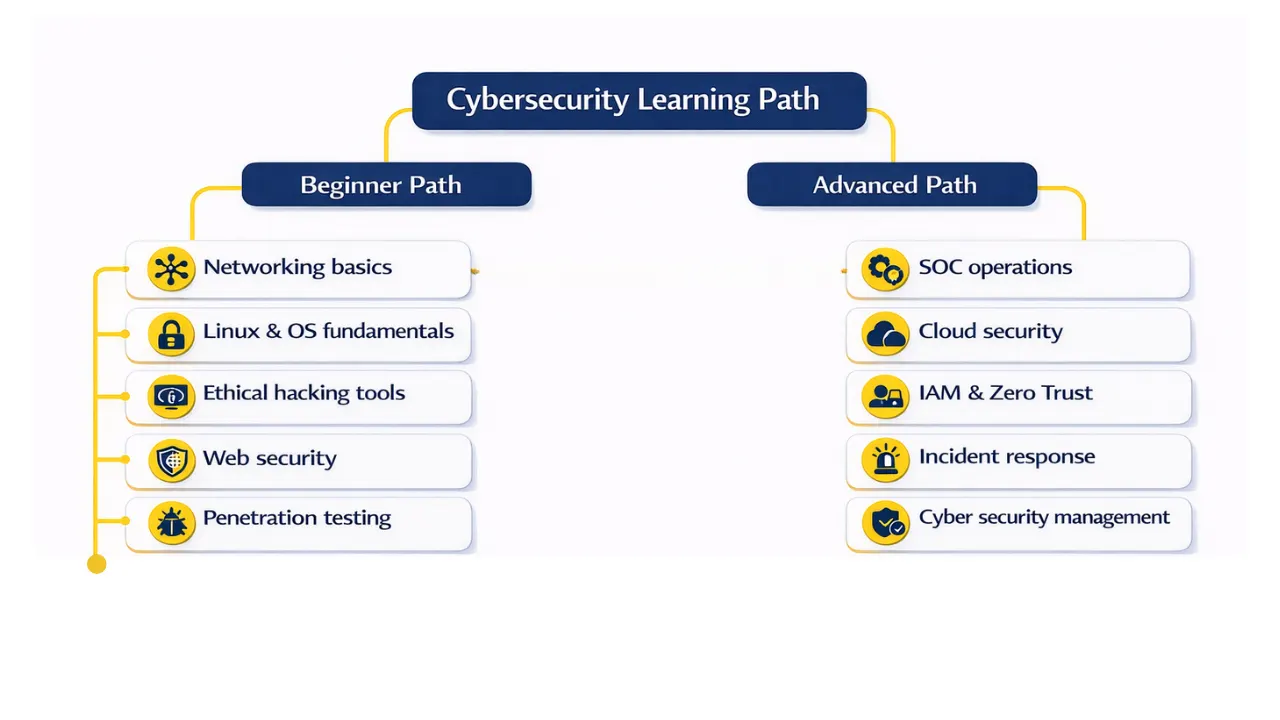
Beginner Path
- Networking basics
- Linux & OS fundamentals
- Ethical hacking tools
- Web security
- Penetration testing
Advanced Path
- SOC operations
- Cloud security
- IAM & Zero Trust
- Incident response
- Cyber security management

Conclusion
When comparing ethical hacking vs cyber security, the choice depends on your interest, mindset, and career goals. Ethical hacking focuses on breaking systems ethically, while cyber security ensures systems remain protected long-term. Both fields are highly rewarding, future-proof, and in massive demand across industries.
Ready to start your journey in ethical hacking or cyber security? Enroll in our industry-aligned cyber security training programs with hands-on labs, real-world projects, and globally recognized certifications. Get expert mentorship, placement support, and up to 30% OFF on selected courses.