

In the world of ethical hacking and cybersecurity, information is power. Before exploiting vulnerabilities or securing systems, ethical hackers first focus on reconnaissance—gathering as much publicly available information as possible about a target. One of the most fundamental reconnaissance techniques involves using Whois tools.
If you’re learning ethical hacking or planning a career in cybersecurity, understanding Whois tools in ethical hacking is non-negotiable. In this guide, we’ll break everything down in simple language—from what Whois is, to how ethical hackers use Whois tools, popular Whois tools, real-world use cases, and best practices.
What is Whois in Ethical Hacking?
Whois is a protocol and database used to retrieve information about domain names, IP addresses, and network owners. When a domain is registered, certain details are stored in a Whois database.
In ethical hacking, Whois tools help security professionals gather publicly available information about a target before performing deeper analysis.
Typical Whois Information Includes:
- Domain owner name or organization
- Registrar details
- Domain creation & expiration date
- Name servers
- Registered email address (sometimes hidden)
- IP address range
Why Whois Tools are Important in Ethical Hacking
Whois tools play a crucial role during the reconnaissance and information-gathering phase of ethical hacking.
Key Benefits of Whois Tools:
- Identify the owner of a domain
- Discover associated IP addresses
- Detect technology footprint
- Understand domain lifecycle
- Help in social engineering analysis
- Assist in attack surface mapping
Also Read: Top 10 Ethical Hacking Course in Kolkata: Duration & Certification
How Whois Tools Work
When you enter a domain name (like example.com) into a Whois tool, it sends a query to a Whois server maintained by domain registrars or regional internet registries (RIRs).
Process Flow:
- User enters domain/IP
- Whois tool sends request
- Whois server responds with stored data
- Tool displays readable information
Popular Whois Tools Used by Ethical Hackers
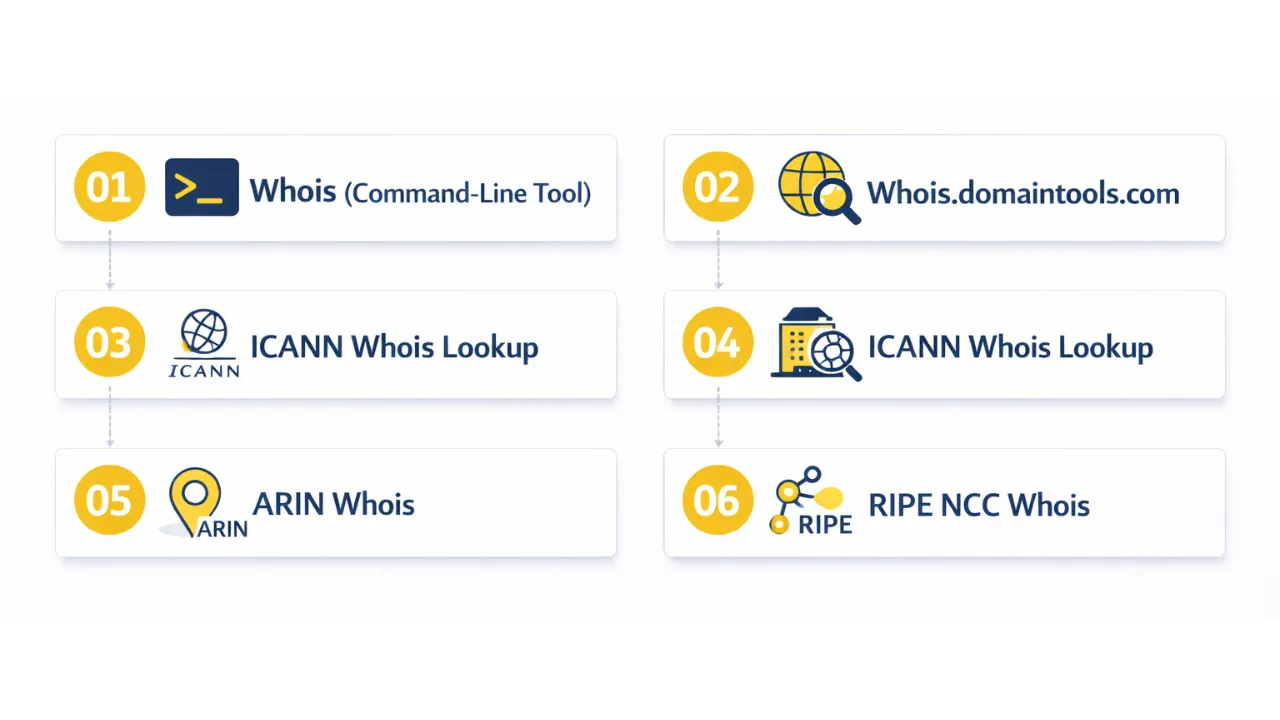
Let’s look at the most commonly used Whois tools in ethical hacking.
1. Whois (Command-Line Tool)
The traditional Whois CLI tool is available on Linux, Kali Linux, and macOS.
Features:
- Fast and lightweight
- Ideal for penetration testers
- Works directly from terminal
Use Case: Perfect for ethical hackers using Kali Linux.
2. Whois.domaintools.com
One of the most powerful online Whois lookup tools.
Features:
- Domain history tracking
- Reverse Whois lookup
- Hosting and IP insights
Use Case: Used by professionals for advanced reconnaissance.
3. ICANN Whois Lookup
ICANN manages global domain registrations.
Features:
- Accurate and official data
- Trusted source
- Clean interface
Use Case: Best for verifying legitimate ownership details.
4. ARIN Whois
ARIN manages IP addresses in North America.
Features:
- IP ownership lookup
- Network range details
- Abuse contact info
Use Case: Useful for IP-based reconnaissance.
5. RIPE NCC Whois
Covers Europe, Middle East, and parts of Asia.
Use Case: Great for global reconnaissance investigations.
6. WhoisXML API
Used for automation and scripting.
Features:
- API-based access
- Bulk Whois lookups
- Threat intelligence integration
Use Case: Ideal for security automation tools.
Practical Use Cases of Whois Tools in Ethical Hacking
1. Domain Enumeration
Ethical hackers identify:
- Parent domain
- Associated domains
- Hosting infrastructure
2. Social Engineering Preparation
Whois data may reveal:
- Admin emails
- Company names
- Registration patterns
3. Detecting Fake or Malicious Domains
Whois helps detect:
- Newly registered domains
- Short-lived domains
- Suspicious registrars
4. Bug Bounty Reconnaissance
Bug bounty hunters use Whois to:
- Identify company assets
- Track acquisitions
- Expand scope legally
Advantages of Using Whois Tools
- Free and legal
- No interaction with target
- Easy to use
- Works globally
- Essential for beginners
Limitations of Whois Tools
Despite their usefulness, Whois tools have limitations:
- Whois privacy protection hides data
- Information may be outdated
- Limited technical details
- Not effective alone
Read More: How to Become Ethical Hacker after Doing cPent Certification in 2025
Best Practices for Using Whois Tools Ethically
- Always stay within legal boundaries
- Use Whois only for authorized testing
- Respect privacy laws
- Combine with other OSINT tools
- Document findings properly
Whois Tools vs Other Reconnaissance Tools
| Tool Type | Purpose |
|---|---|
| Whois | Domain ownership & registration |
| Nmap | Network scanning |
| Shodan | Internet-connected devices |
| Sublist3r | Subdomain enumeration |
| Maltego | Relationship mapping |
Conclusion
Understanding Whois tools in ethical hacking is essential for anyone entering cybersecurity. These tools help you think like a hacker—by observing, analyzing, and mapping digital footprints without touching the target system.
Whether you are:
- A beginner in ethical hacking
- A cybersecurity student
- A bug bounty hunter
- A SOC analyst
Whois tools will always be part of your toolkit. Want to master ethical hacking tools like Whois, Nmap, and Shodan with hands-on practice? Enroll in a professional Orbus ethical hacking course and start your journey toward a high-paying cybersecurity career today!